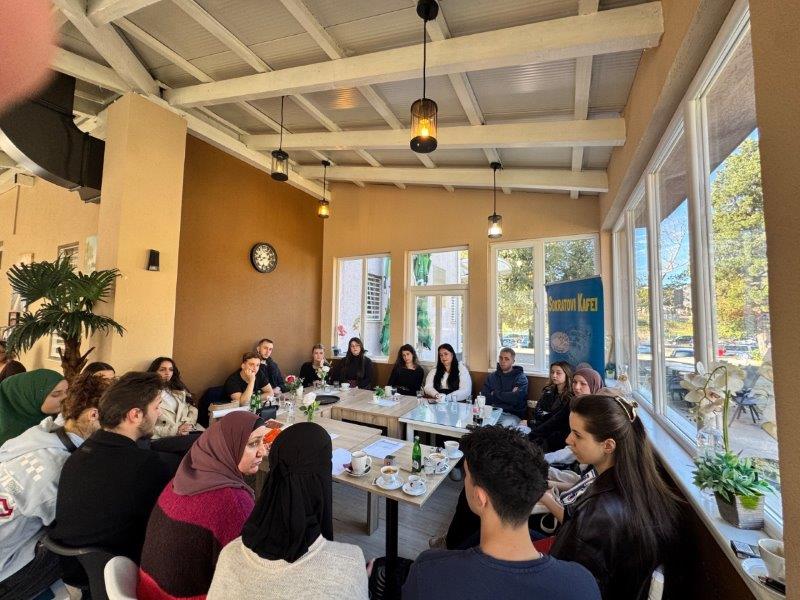
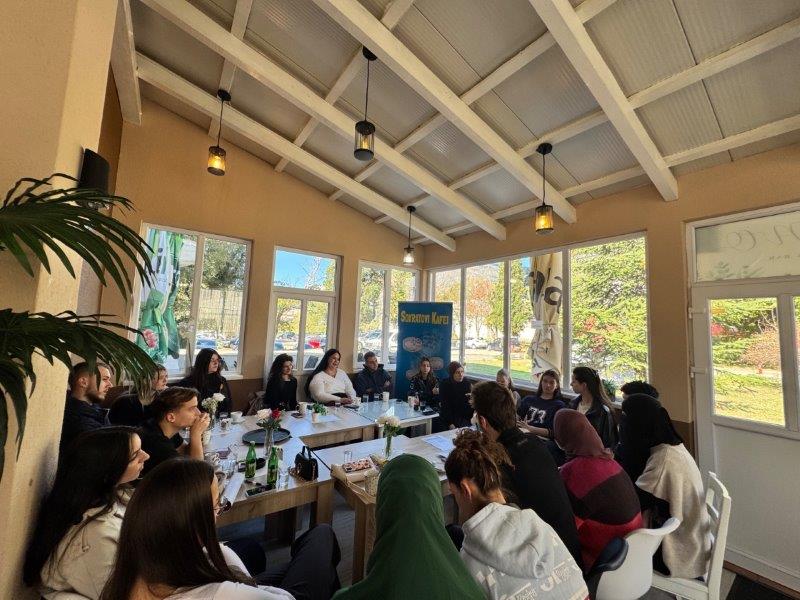
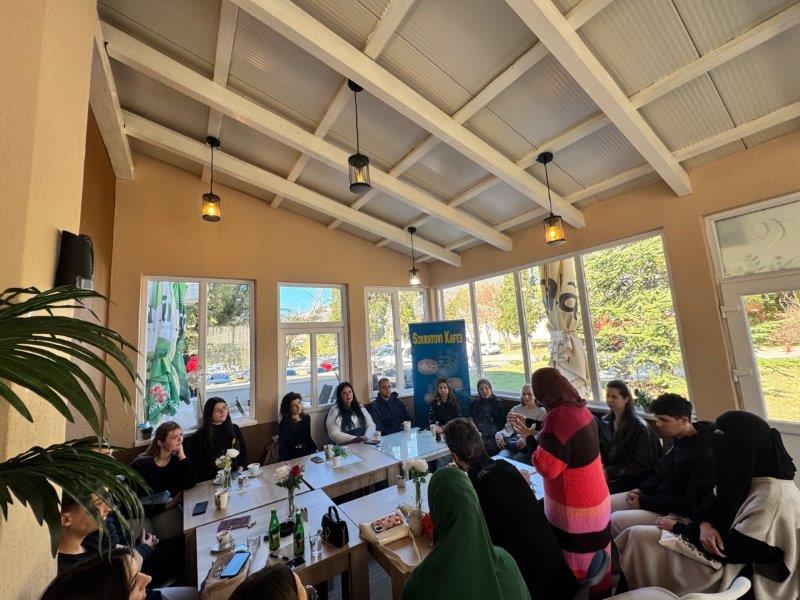
Can we preserve what we consider priceless—our values, emotions, dignity, and authenticity—in a world where almost everything has a price? This question opened the first Socrates Café of the autumn series, held on October 28, 2026, in Mostar. The discussion, titled “When Everything Becomes a Commodity, Can Values and Emotions Remain the Exception?”, was facilitated by Prof. Dr. Merima Jašarević, who encouraged participants to reconsider the boundaries between what has a market price and what holds immeasurable value in our lives.
What is something we would never sell? Our integrity, convictions, dignity, friendship, or love? Although the answers may initially seem straightforward, the discussion revealed how difficult it is to draw a clear line between the market and the most intimate aspects of our lives. Market logic has long extended beyond the economy, increasingly penetrating education, professional relationships, privacy, emotions, and the ways we present ourselves to others.
Particular attention was devoted to the question of how we often turn ourselves into commodities, sometimes without even realizing it. By sharing personal content on social media, following trends, cultivating a desirable digital image, and constantly seeking visibility, we participate in an attention economy in which our lives, experiences, and emotions become content that can be valued, exchanged, and monetized. Even when we are not directly selling anything, our time, attention, and privacy carry market value.
The discussion also explored the growing use of artificial intelligence, particularly AI chatbots, which are increasingly becoming spaces for conversation, emotional support, and a sense of connection. What happens when our need to be heard, understood, and accepted becomes part of a commercial offering? Can a sense of closeness be purchased, and can digital interaction replace authentic human relationships?
Another central theme was our need for social validation and acceptance. Why is it so important for us to be seen, recognized, and affirmed? Could our pursuit of likes, our tendency to follow trends, and our constant desire to stay connected actually reflect a profound human need to belong? And if belonging is one of our fundamental needs, what happens when it, too, becomes a commodity that the market sells back to us every day?
Rather than offering simple answers, the discussion created space for participants to reconsider their own choices. Perhaps the balance lies not in completely withdrawing from the market and the digital world, but in self-awareness, critical thinking, and consciously defining our own boundaries. When, where, how, to what extent, and for what purpose do we present ourselves to others? Do we do so because we have freely chosen to, or because we feel pressured to remain visible, desirable, and accepted? Once again, Socrates Café demonstrated the importance of philosophical dialogue in everyday life. Its value lies not in finding a single correct answer, but in our willingness to ask uncomfortable questions, challenge what we take for granted, and recognize our own responsibility in shaping society.
Perhaps the most important question, then, is not whether everything has a price, but whether we can still distinguish between what has a price and what has value.