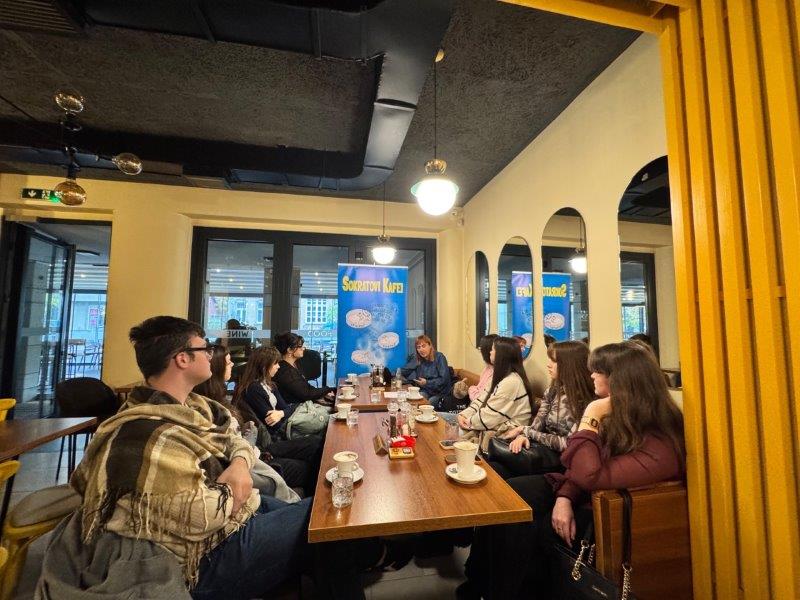
Can we speak of individual environmental responsibility when citizens do not have a genuine freedom of choice? This question was at the heart of the Socrates Café held on November 10, 2026, in Tuzla. Together with Professor Selma Veseljević Jerković, participants explored the topic “Who Bears the Burden of Environmental Responsibility for the Planet?”, examining the relationship between personal responsibility, economic inequality, and political power.
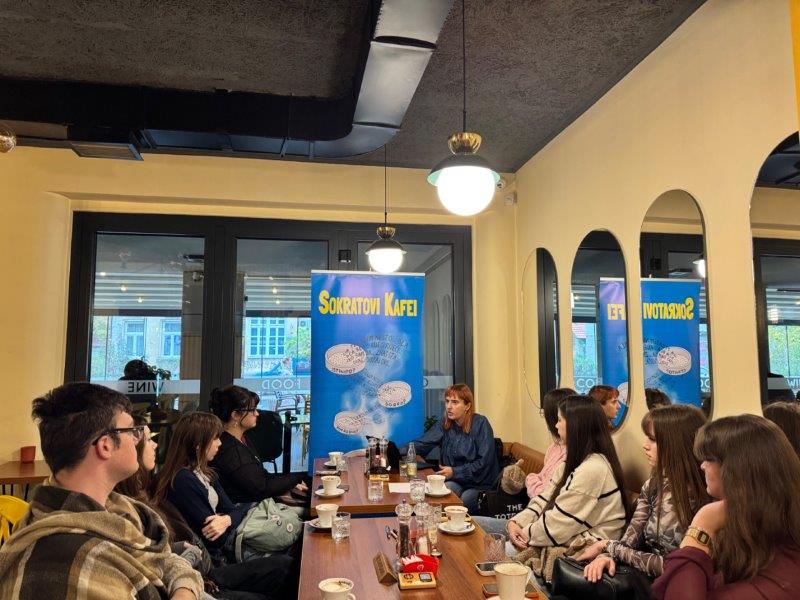
The discussion highlighted that the environmental crisis is not merely a matter of environmental protection but also a question of social (in)justice. Using public transportation and household heating as examples, participants questioned the extent to which environmentally responsible choices are genuinely accessible to the majority of the population. Although individuals are frequently encouraged to change their habits, economic circumstances prevent many people from adopting more environmentally sustainable solutions.
Particular attention was given to public transportation in Bosnia and Herzegovina. Drawing on their personal experiences, participants pointed out that underdeveloped infrastructure, unreliable services, and limited accessibility force many citizens to rely on private vehicles, even when doing so places a considerable financial burden on them. This raised an important question: How justified is it to shift responsibility for pollution onto individuals when institutions have failed to provide functional and accessible alternatives?
The conversation then broadened to questions of political accountability, civic activism, and the potential for social change. Participants reflected on the limits of individual action, as well as the causes of social apathy and learned helplessness. Student protests in Serbia and their influence on political developments were discussed as an example of the importance of civic mobilization, prompting further reflection on how organized collective action can bring about meaningful change.
One of the key conclusions of the discussion was that individual responsibility cannot replace systemic solutions, but systemic change cannot occur without civic engagement either. Environmental justice requires accountable institutions, accessible public services, and policies that recognize the differing economic circumstances of citizens. At the same time, it requires citizens who are willing to question the status quo, hold elected representatives accountable, and initiate change.
The Socrates Café in Tuzla concluded with a reflection on how change often begins with a single individual step, even when that step is uncomfortable, difficult, or taken alone. After all, responsibility for the planet cannot rest solely on individuals, but neither can the need for systemic change serve as an excuse for passivity in the face of injustice.
Organized by the TPO Foundation, Socrates Café continues to provide a space for critical thinking, dialogue, and collective reflection on the social issues that shape our everyday lives.