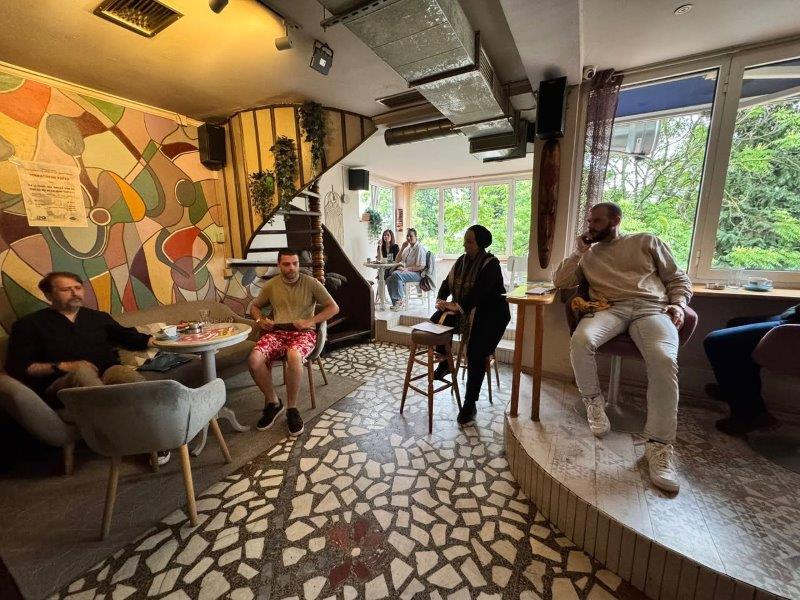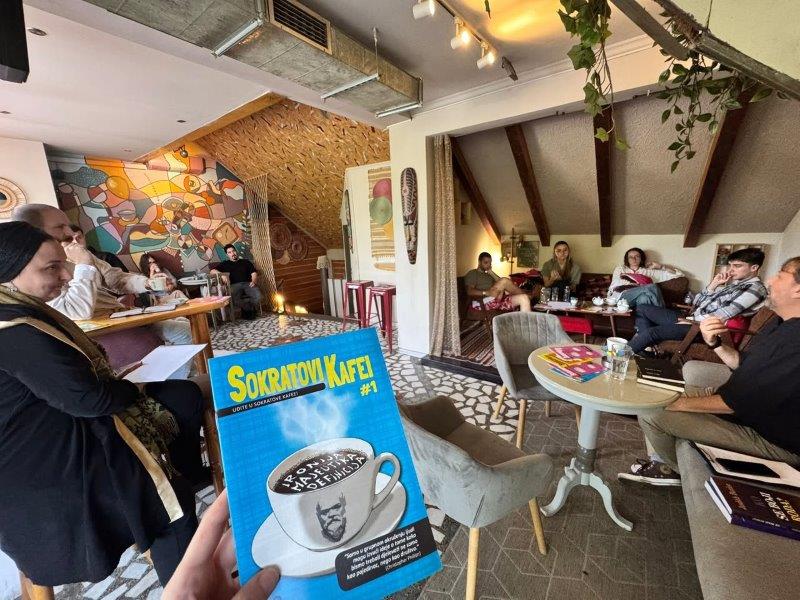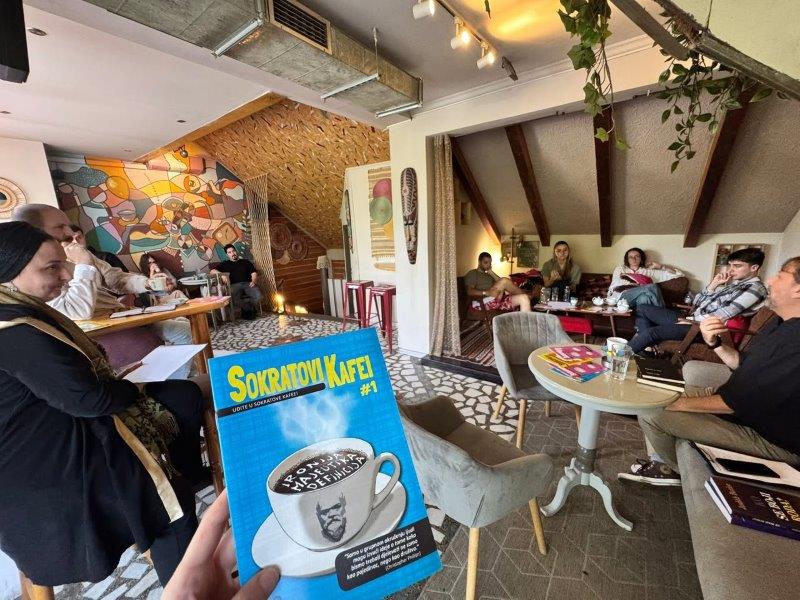
In the beautiful and inspiring atmosphere of Café Eklektika in Banja Luka, on June 3, 2026, a Socrates Café was held, dedicated to one of the oldest and deepest philosophical questions: Does life have meaning in itself, or do we give meaning to it? The conversation was led by Dr. Željko Šarić, while the meeting was moderated by Ernada Fatima Avdibegović.
In an open and stimulating atmosphere, the participants reflected on the meaning of life from various perspectives: philosophical, religious, existential, scientific, and everyday human perspectives. The initial question opened a series of new dilemmas. If we know that nothing comes from nothing, how, then, can we understand the origin of the world and life? Is the meaning of life something that exists independently of us, woven into existence itself, or is it a meaning that people create themselves through relationships, experiences, love, faith, work, suffering, and hope? Can life have meaning only through biological continuity and the continuation of the species, or does meaning transcend the mere fact of existence?
A particularly interesting part of the conversation focused on the question of whether human beings give meaning to their own lives, making meaning a deeply subjective experience, or whether meaning comes from something greater than the human being — from faith, spirituality, an ethical order, or a sense of connectedness with the world. For some participants, faith is the key source of meaning, while others emphasized that meaning can also emerge through human responsibility, freedom of choice, creativity, and care for others.
The discussion also opened questions of love, evolution, and culture: What evolutionary purpose does love serve? Is it merely a biological mechanism of survival, or an experience that shapes our humanity? Can culture change the way we understand our own nature, and even influence patterns of behavior that we often attribute to biology and genetics?
The conversation took us in many directions, perhaps even further than we had expected at the beginning. Yet this is precisely the value of the Socrates Café: not in quickly arriving at one final answer, but in thinking together, listening, questioning, and opening new questions. The participants did not reach one universal conclusion, but they demonstrated how important it is to create spaces in which great questions of life can be discussed freely, thoughtfully, and with respect for different beliefs.
The Socrates Café in Banja Luka once again confirmed that philosophy is not only an academic discipline, but a living practice of conversation about what concerns us most deeply. And what do you think: does life have meaning in itself, or do we give meaning to it?