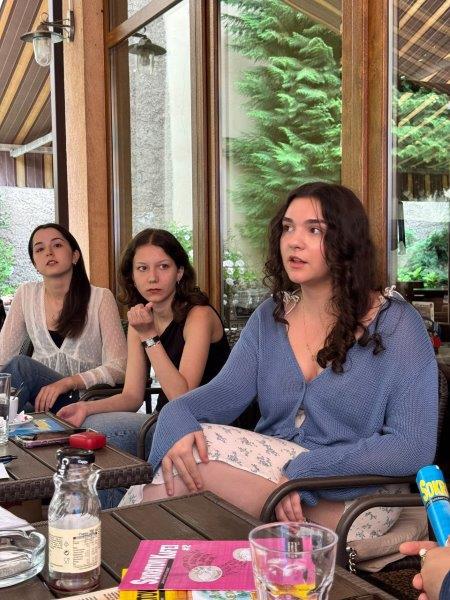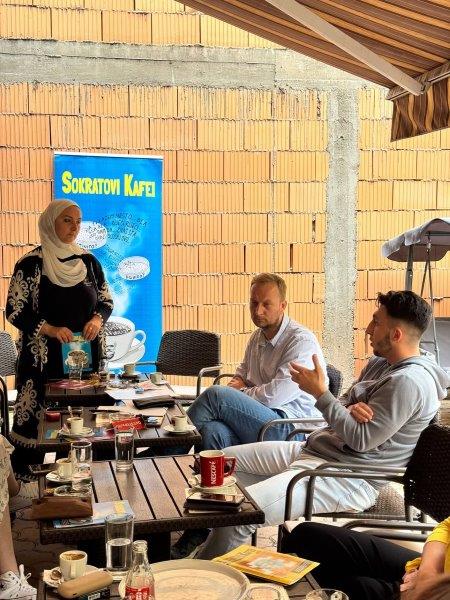
On June 6, 2026, a Socrates Café was held in Zenica on the topic: “Is Patriotism a Virtue or an Obstacle?” This timely topic brought together young participants who reflected on the meaning of patriotism in contemporary society, particularly in the context of Bosnia and Herzegovina, together with Professor Senad Arnaut and moderator Ernada Avdibegović.
Professor Senad Arnaut introduced the participants to the concept of patriotism throughout history, as well as to the ways in which ancient philosophers such as Socrates, Plato, and Aristotle reflected on the relationship between the individual, the community, and the state. This introductory overview opened questions about whether love for one’s homeland can be understood as a moral virtue, civic responsibility, and care for the common good, or whether it can become an obstacle when it turns into exclusion, intolerance, and blind loyalty.
The participants emphasized that in our society, patriotism, even when it exists as a sincere emotion or sense of belonging, is often manifested in a negative way, through nationalism, extremism, divisions, political slogans, or declarative expressions of love for the homeland without real responsibility toward the people who live in it.
The young participants stressed that true patriotism should not mean hatred toward others, nor the glorification of one’s own group at the expense of other peoples, cultures, or identities. On the contrary, patriotism could be a virtue when it implies responsibility, solidarity, care for the public good, respect for the law, protection of nature, readiness for dialogue, and contribution to the community. In this sense, love for one’s homeland is not shown only through words, flags, or symbols, but through everyday actions: caring for people, advocating for a more just society, respecting diversity, and being willing to speak critically about problems.
During the discussion, the question was also raised as to why positive examples of patriotism are less often recognized and even less often presented in the public sphere. The participants concluded that society often pays far more attention to conflicts, divisions, and negative phenomena, while beautiful and constructive initiatives remain less visible. As a result, one may get the impression that apathy, nationalism, and mistrust are the dominant forms of relating to society, although there are many individuals and communities who, through their work, solidarity, and responsibility, show a different face of patriotism.
The Socrates Café in Zenica showed that young people want to discuss topics that deeply concern them, but also that they need spaces in which they can freely and thoughtfully reflect on society, identity, belonging, and responsibility.
In the end, the question remains for all of us: what kind of patriotism do we want to cultivate, one that divides and excludes, or one that calls us to build together a better, more just, and more open society?