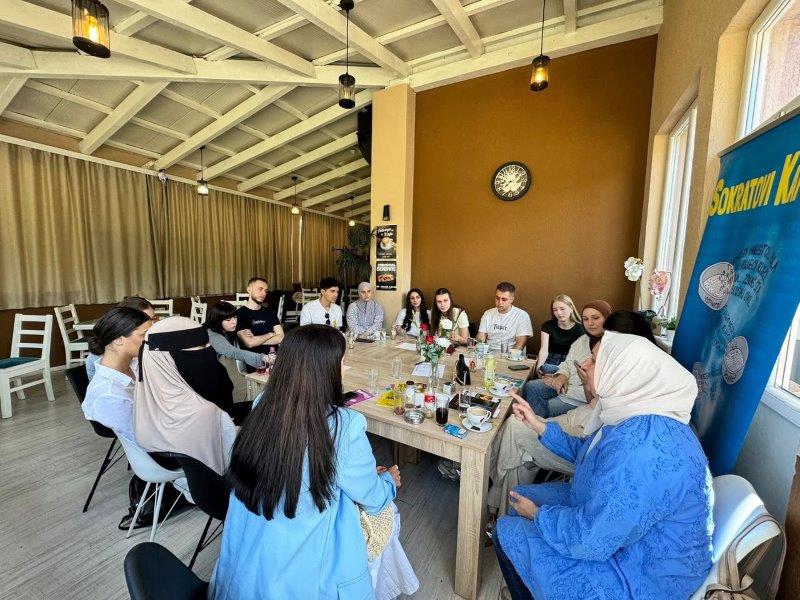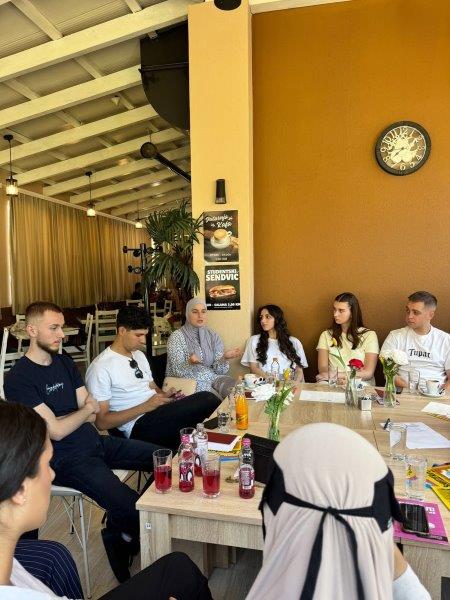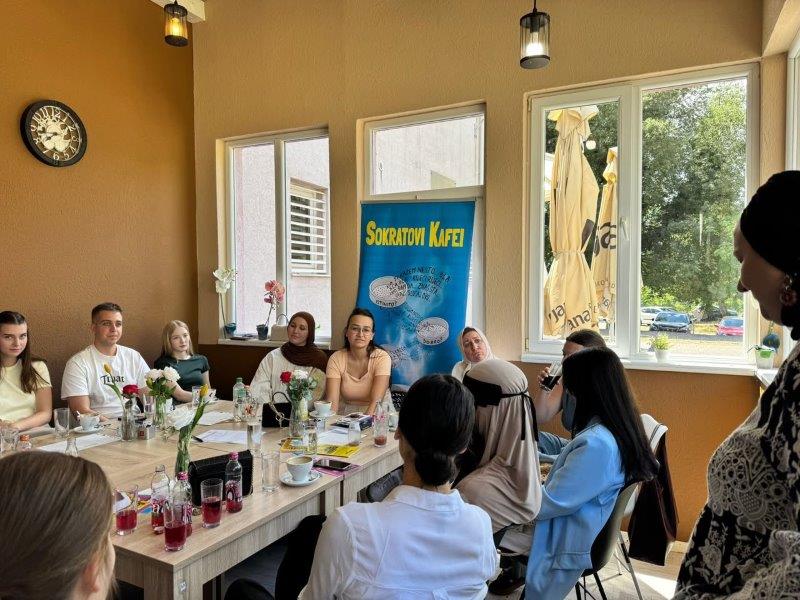
On June 4, 2026, a Socrates Café was held in Mostar, dedicated to the question: Is culture manipulative? The discussion was led by Prof. Dr. Sci. Merima Jašarević from the Faculty of Humanities of Džemal Bijedić University in Mostar, opening a space for reflection on how culture, social environment, family, education, and contemporary media shape our identities, values, behaviors, and the ways in which we understand the world around us.
The starting point of the conversation was the recognition that culture and the environment in which we grow up undoubtedly shape us to a great extent. People born and raised in different places, social circumstances, families, and educational systems are often formed in different ways. The language we speak, the customs we adopt, the values we consider “normal,” and even the ways in which we express emotions, choose our life paths, or judge other people are deeply connected to the cultural patterns in which we live.
The participants questioned whether culture merely shapes human beings or whether it sometimes subtly directs, limits, and manipulates their choices. As social beings, people have a strong need to belong to a community. For this reason, we often accept the dominant opinions, expectations, and norms of our environment, even when they do not fully correspond to our inner feelings, beliefs, or experiences. It was particularly emphasized that in today’s time, marked by cancel culture and strong pressures of public opinion, many people conceal what is authentically their own if it differs from the views of their surroundings.
However, the conversation also opened an even deeper question: how much of what we consider “our own” is truly our own? To what extent are our attitudes, tastes, beliefs, acts of rebellion, and choices the result of our free will, and to what extent have they been formed under the influence of family, education, society, culture, media, and trends? Even when we oppose something that is generally accepted, the question arises whether that rebellion is an authentic act of freedom or whether it too has been shaped by another cultural pattern, ideology, or contemporary trend.
During the discussion, the participants also touched upon various customs and experiences transmitted by culture. They spoke about beautiful customs that connect people, preserve memories, strengthen a sense of belonging, and give meaning to shared life. At the same time, they also discussed negative, harmful, or burdensome cultural practices that can limit the individual, especially when they impose rigid gender roles, social expectations, prejudices, or fear of different opinions.
A special part of the conversation was dedicated to social media and its influence on culture and society. The participants reflected on how the digital space changes the way we communicate, spend our time, learn, gain experiences, and form opinions. Today, social media does not merely transmit cultural content; it also creates it, accelerates it, simplifies it, and often turns it into trends. In this process, the boundary between free choice and manipulation becomes increasingly unclear.
The Socrates Café in Mostar demonstrated how important it is to think critically about culture — not in order to reject it, but to better understand its power. Culture can be a space of belonging, beauty, solidarity, and identity, but it can also be a mechanism of pressure, exclusion, and control. This is precisely why it is important to ask questions, engage in dialogue, and learn to recognize the difference between values that enrich us and patterns that limit us.
Like every good philosophical conversation, this meeting did not offer one final answer. Instead, it opened new questions about freedom, belonging, authenticity, and responsibility. And the question remains for all of us: does culture only shape our identity, or does it sometimes manipulate it?